

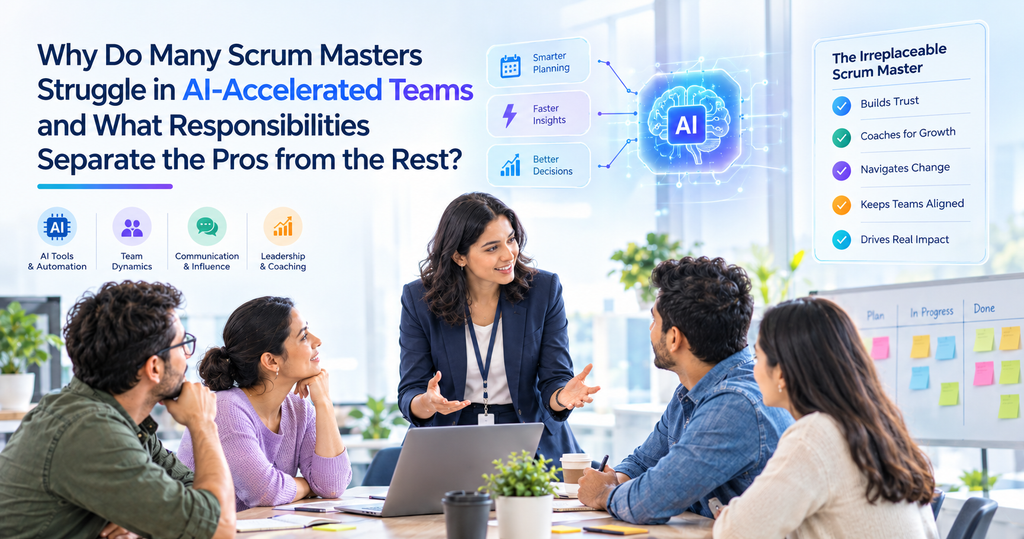
Artificial intelligence is changing the way Agile teams work, and not all Scrum Masters are changing at the same speed. The focus on how to best facilitate Scrum is no longer enough for Scrum Masters. You need to think about how you help teams make better decisions when AI is able to do analysis, coding, testing, documentation, and other work at a much faster clip. Explore CSM Certification Training to boost your core skills as a Scrum Master for the changing workplace.
Why do Scrum Masters struggle in AI-accelerated teams?
The role of the Scrum Master was never about simply facilitating daily scrums or ensuring that a team is doing Scrum. However, in AI-assisted workflows, deficits in facilitation, collaboration, prioritization, and coaching can be much more obvious.
Today a team could probably code much faster, sum up requirements in a flash, use AI to instantly generate test cases, or analyze data. But speed is not worth it.
The Scrum Master will have to partner with the team to ask a critical question: are we leveraging AI to deliver more customer value or are we just working faster?
That is the difference between a Scrum Master focused on process and a Scrum Master focused on results.
Artificial intelligence can help teams to do more but there are still human skills that are important, such as collaboration, shared understanding, ownership, and accountability, which are areas where a good Scrum Master can still add value.
What are the responsibilities of a good Scrum Master?
1. Enabling Better Decisions, Not Just Better Meetings
A poor Scrum Master may measure success by whether Scrum events are held. But a better Scrum Master knows that events are only as useful as the outcomes they facilitate.
In an AI-accelerated team there may be more options and more information than ever before, and the Scrum Master needs to lead the team to make the right choices.
For example, where AI is used to generate technical options, it is the team that makes the choice, not the Scrum Master. But the Scrum Master can assist the team to understand the implications of different options, identify risks, and ensure decisions are made with quality and customer value in mind.
2. Allow Teams to Leverage AI While Retaining Accountability
AI output still needs to be vetted. A Scrum Master can assist teams in establishing good practices for reviewing AI documentation, requirements, or code and ensure everyone understands when human review is necessary.
These talks could be on:
- Review AI-generated code or documentation
- Requirements and assumptions validation
- Security or quality issues
- Take ownership of the outcome
- When human review is required
The goal is not to fight the use of AI but to ensure accountability rests with the people and not the tools.
3. Protecting Collaboration in an Age of Automation
AI and other technologies can reduce repetitive tasks. But when humans start to become too reliant on automation, it can hurt collaboration.
The Scrum Master should be able to see when the team is becoming too reliant on automation and ensure that there are still opportunities for peer reviews, design discussions, collaborative problem-solving, and other knowledge-sharing activities.
The future Scrum Master is a human enablement professional, and humans still have to collaborate to create shared understanding.
4. Coach teams to be outcome-oriented
The use of artificial intelligence may distort what we think productivity is. When teams start working with AI, they may be able to do a lot more than they used to, but that doesn’t always translate to value.
A good Scrum Master knows that it’s outcomes, not outputs, that count. That means shifting the team’s mindset from questions such as
“How much did we get done?” … to questions like, “What’s changed for the customer because of what we delivered?”
5. Emphasize Ongoing Improvement
Teams using AI-assisted workflows need to continue to improve as much as any other team, if not more, because change happens faster.
A Scrum Master may help the team reflect on: After each sprint:
- What worked?
- How did AI help in this process?
- What were the dangers introduced by artificial intelligence?
- What should we do differently?
- What do we try next?
For instance, a team may discover that AI-assisted test generation helps them go faster but also produces repetitive tests that need extra maintenance. And rather than completely throw out AI-assisted testing, the team could look for ways to improve the process.
This is exactly the kind of continuous improvement that makes a Scrum Master so valuable.
Will AI replace the Scrum Master?
No, really not. While artificial intelligence can help to complete some tasks more quickly or efficiently, there are aspects of the Scrum Master role that go well beyond task completion.
The Scrum Master’s job is to enable and support the team, which means removing impediments, facilitating, coaching, and helping the team evolve and improve. All these responsibilities require a high degree of situational and contextual intelligence, something AI is not yet able to do.
To summarize, the more sophisticated AI gets, the more a Scrum Master will need to improve their people skills.
What Skills Should an AI-Ready Scrum Master Develop?
For a Scrum Master to be ready for the future, it is recommended to invest in a balanced mix of Scrum knowledge, facilitation skills, business acumen, and technology awareness.
Key skills to develop include:
- Facilitation: Creating clarity and enabling decisions
- Coaching: Filling the team’s perceived needs, not empowering the team
- Conflict resolution: handling disagreement and resolving conflict
- Outcome Thinking: Connecting work to product / customer value
- AI awareness: How to use technology to improve team performance
- Critical thinking: Asking questions, evaluating alternatives, looking for evidence
- Communication: Building mutual understanding, particularly between technical and non-technical stakeholders
- Continuous improvement: Experimenting and using the knowledge gained to make real change
Professionals who are interested in Scrum at scale, including roles such as Scrum Master for multiple teams or larger programs, may benefit from an SSM Certification Course to build a deeper understanding of these responsibilities.
How Scrum Masters Remain Relevant?
The best Scrum Masters will become subject matter experts in what they do and continue to learn and adapt as the environment changes.
This means building a strong Scrum foundation and then continuing to grow facilitation skills, like events, conversations, and coaching. Then learn about AI and how it is applied in your workplace and identify ways it can help the team achieve its goals while adhering to quality standards and avoiding excessive or misplaced automation.
A good personal development plan for a Scrum Master who wants to thrive in an AI-assisted environment might be:
- Learn something new (about Scrum, facilitation, or AI)
- Try it at work
- Check if it makes a measurable difference
- Reflect on what you have learned.
- Add your own knowledge
For example, you could use an AI-assisted method to document a Sprint, see if it helps you save time, and determine if this actually benefits the team. The real value of Scrum Master training is that learning is only useful if you can apply it.
Simpliaxis can be considered a learning resource for professionals seeking to build foundational, procedural proficiency in Scrum and Agile methodologies through certification-oriented courses and training. The right learning path will vary for each person, considering their experience and career aspirations.
Conclusions
AI-enabled teams will probably need Scrum Masters but not the ones who know the most about the Scrum Guide or can shield the team from outside interference.
The best Scrum Masters will be the ones who can help teams make better decisions, hold teams accountable even with automation, promote collaboration, think critically about results and not deliverables, and always be experimenting and improving their processes.
Structured learning can be an important first step for professionals who want to prepare for the future as a Scrum Master to develop these competencies. If you want to build or enhance your Scrum knowledge and prepare yourself for the changing workplace, check out CSM training from a reputable course provider like Simpliaxis and find the learning path that matches your goals.
